Most customers read reviews before contacting a business. Research shows that 91 percent of consumers check online reviews before making a purchase, so a business’s reputation influences revenue well before any sale. For small business owners without a PR or marketing team, this can seem daunting. Fortunately, a best online reputation management strategy does not require a large staff or budget. It relies on the right structure, habits, and tools working together.
Why Can’t Small Businesses Ignore Online Reputation Anymore?
Reviews once influenced only first impressions, but now search engines consider review volume, recency, and ratings in local rankings. Businesses with strong reviews are more likely to appear in local searches, while those with few or outdated reviews may lose visibility, regardless of service quality.
The greater risk comes from unaddressed reviews. An unanswered negative review affects not only the first customer but also future customers who read it and choose not to engage. This silent loss is hard to measure but accumulates over time. Small businesses need a structured online reputation management tool, rather than relying on memory or occasional checks.
What Does a Strong Online Reputation Management Strategy Actually Include?
A reliable strategy relies on four interconnected habits.
- First, capture feedback early, before a frustrated customer feels compelled to complain publicly. Proactively contacting customers after a service or purchase helps businesses to resolve issues discreetly.
- Second, respond quickly. Many businesses take up to three days to reply to reviews or messages, which can weaken trust. Prompt responses demonstrate attentiveness and commitment toward customer satisfaction.
- Third, motivate satisfied customers to leave public five-star reviews. Most happy customers do not review without a prompt, so timely requests have a significant impact.
- Fourth, monitor patterns over time. While a single negative review is just one data point, repeated complaints indicate a need for service improvement.
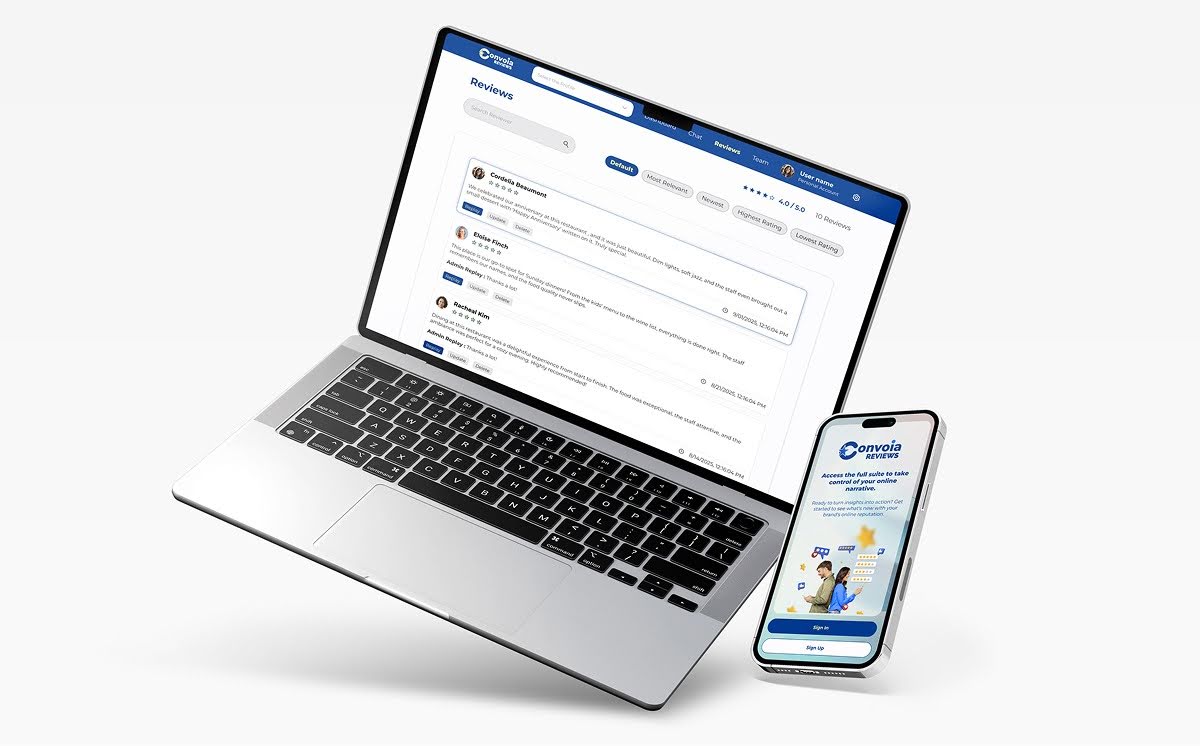
Convoia Reviews is one of the best online reputation management system that is designed around these four habits, combining feedback capture, rapid response tools, and review generation into a single system.
Why a Review Management Platform Beats Manual Tracking?
Many small business owners initially manage reviews with spreadsheets, browser tabs, and reminders to check Google. While this works temporarily, it does not scale. As customer volume increases, negative feedback can be missed simply because it was not seen in time.
A review management platform handles this by centralizing SMS, email, Google reviews, and social messages in one dashboard. This allows business owners or team members to view and respond to all feedback in one place, eliminating the need to switch between multiple apps. The features are meant to streamline communication.
Key Features to Look for in an Online Reputation Management Tool
Not all online reputation management tools offer the same capabilities. Small businesses should prioritize features that simplify customer communication, streamline review management, and support long-term reputation growth.
- Multi-location management: Keep reviews, messages, and customer interactions organized for each business location from a single dashboard.
- Dedicated business phone numbers: Assign a unique business phone number to each location to separate personal and business communications while establishing a local presence.
- Real-time sentiment alerts: Receive instant notifications when negative reviews or customer interactions occur, allowing your team to respond promptly.
- Automated follow-up scheduling: Send timely review requests and customer follow-ups after purchases, appointments, or services without manual effort.
- Complete interaction history: Maintain a centralized archive of calls, messages, reviews, and customer conversations to provide context and deliver more personalized support.
Businesses that consistently use these features are better positioned to maintain average ratings of four stars or higher. Hundreds of businesses across multiple industries have already put this to the test, generating thousands of verified reviews per location. Convoia Review’s results speak to how consistent, structured review management compounds over time.
How an Online Review Management System Converts Feedback Into Growth?
An online review management system does more than organize feedback. It transforms customer communications into public proof of quality. Requesting reviews from satisfied customers at the right time and through the right channel turns positive experiences into five-star reviews.
Businesses using automated systems regularly see measurable results quickly, with some obtaining more five-star reviews within a few days. This level of growth is difficult to achieve manually, as it relies on consistent timing and follow-up. Businesses interested in these results can start a free trial to measure the impact directly.
Compliance Matters: Avoiding Review Gating
Speed and automation are only useful if they stay within lawful limits. Review gating, the practice of selectively asking only satisfied customers for a review while skipping unhappy ones, has become a specific enforcement target for regulators. The Federal Trade Commission warned companies with respect to potential violations of its Consumer Review Rule, which prohibits suppressing certain reviews along with other deceptive review practices, and which allows for civil penalties per violation.
For small businesses, the safest long-term strategy is to request feedback from every customer, not just those likely to respond positively. Automated processes that follow up with all customers help maintain compliance and improve the overall review profile over time.
Data-Driven Reputation Management: Going Beyond Just Reviews
Reviews are only one aspect of reputation management. Understanding customer sources and post-engagement actions adds further value. Source attribution reveals which channels, such as organic search, Meta ads, or Google Ads, generate leads. Conversion tracking links conversations to booked appointments, demonstrating the true return on marketing investment. Custom reporting enables businesses to filter results by date or source and export data for deeper analysis.
The Convoia Review’s Data-Driven Insights dashboard provides that visibility, turning raw conversation data into actionable decisions for small businesses.
Choosing the Right Plan for Your Business Size
A single-location business typically needs core review management, fast response tools, and basic automation to organize customer feedback. Businesses with multiple locations or higher customer volume benefit from full-service support, including teams that initiate review requests and monitor low ratings. Choosing a plan that fits the business’s size and complexity prevents paying for unused features and allows for future growth.
Start Turning Reviews Into Revenue
Building an effective online reputation management strategy does not require guesswork or a full-time hire. It includes capturing feedback early, responding quickly, maintaining compliance, and using an automated system. Small businesses ready to implement this strategy can explore Convoia Reviews and start a free trial to see results firsthand.
FAQs
What is online review management?
Online review management is the process of tracking, collecting, and responding to customer reviews across sites like Google, so a business can protect its reputation and act on feedback before it affects future customers.
Why do small businesses need a review management platform?
A review management platform keeps feedback organized, speeds up response times, and helps a business build stronger trust across Google and other review sites without relying on manual tracking.
What’s the difference between reputation management software and manual review tracking?
Manual tracking depends on someone remembering to check multiple platforms and follow up individually, which does not scale as customer volume grows. Reputation management software centralizes those tasks, automates follow-ups, and flags negative sentiment in real time.
What happens after a free trial ends?
A business can choose to upgrade to a paid plan if the results meet expectations, or simply stop using the service with no charges applied. Most businesses see measurable results within the 30-day trial window.
Is review gating illegal?
Review gating itself is not automatically illegal, but selectively suppressing negative reviews to inflate a public rating can violate the FTC’s Consumer Review Rule. Businesses that request feedback from all customers, not just satisfied ones, stay compliant while still improving their review profile.
How quickly should a business respond to a negative review?
A response within 24 to 48 hours is considered best practice. Faster responses signal accountability to both the reviewer and future customers who read the review later.
Does review management software work for multi-location businesses?
Yes. Multi-location businesses benefit most from centralized dashboards that separate reviews, messages, and phone numbers by location while still allowing owners to monitor performance across all sites from one place.
Can review management software help with SEO?
Yes. Search engines factor review volume, recency, and rating into local search rankings, so businesses that consistently generate fresh, positive reviews tend to see stronger visibility in local search results over time.
What is the ideal number of reviews for a small business to maintain?
There is no fixed number, but consistency matters more than volume. A steady stream of new reviews each month signals an active, trustworthy business, while a stagnant review count can suggest reduced activity even if past ratings were strong.
Should a business respond to positive reviews too?
Yes. Responding to positive reviews reinforces customer relationships and shows potential customers that the business is engaged, not just reactive to complaints. A short, genuine reply is usually enough.